
The Tawny Owl – Strix aluco
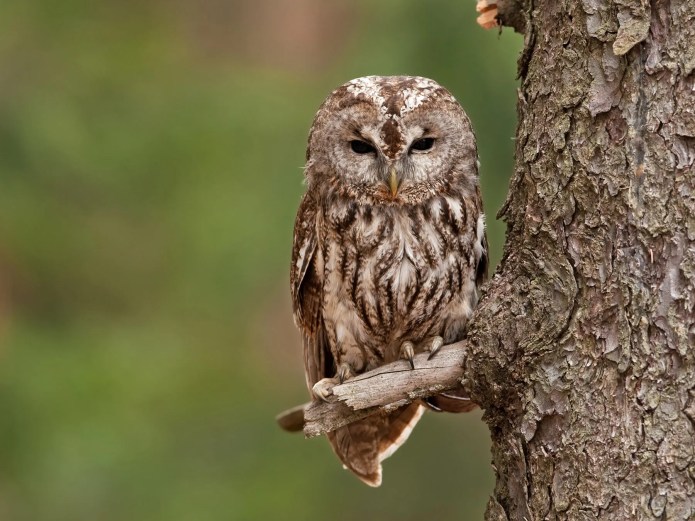
The Tawny Owl , Strix aluco Is the most common species of owl here in the U.K. with an estimated population of around of around 55,000 breading pairs. Luckily for myself , one pair call the Meadow home and are visible most days roosting in a tree adjacent to the hide. Tawnies are highly territorial with a home range of between 30 to 50 acres and are primarily a woodland species, but have adapted to live almost anywhere there are trees, including city parks, wooded urban and suburban gardens, farmland hedgerows and copses, as well as more extensive areas of woodland and forestry. The home range is typically established in the late autumn, and defended throughout the winter until the spring when breeding commences.
Because they don’t like flying over water they are absent from many of our islands here in the U.K. including the Isles of Man and Wight, as well as the Outer Hebrides, Orkney and Shetland.
Most Tawny Owls have a lifespan of around 4 years . They are responsible for the most commonly heard owl sound, the classic, nocturnal ‘twit twoo’ call, with which most people are familiar: The female is normally larger and weighs more than the male bird.
Diet comprises predominantly of small mammals, such as mice , voles and other small rodents. Additionally they will sometimes take rabbits, moles, small birds, beetles, earthworms and frogs.
Like almost all owls, the wings of a tawny owl are completely silent.
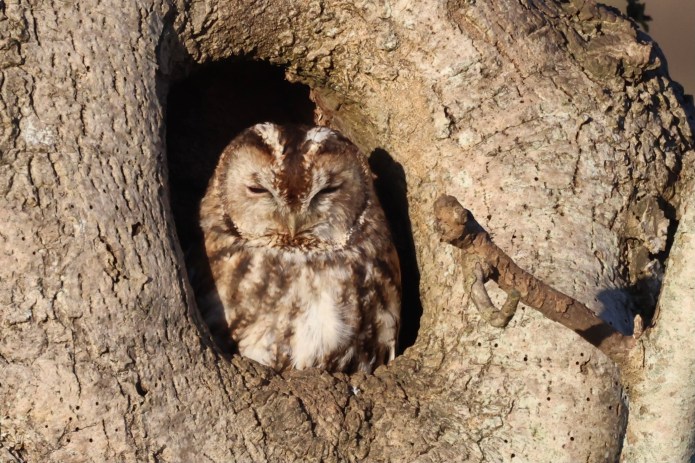
Tawny Owls will nest in a variety of places but prefer tree cavities where available. However, in the absence of a suitable cavity they will use other natural sites including old crow or pigeon nests, squirrel drays, the forks of tree trunks, and even rabbit holes. They take readily to artificial sites including nesting boxes.
Only one clutch of eggs is laid, usually in the late winter or early spring. Clutch size is typically 2-3 eggs and incubation lasts for approximately 30 days. Fledging occurs around 5 weeks of age, although young Tawny Owls tend to leave the nest earlier than this during their ‘branching’ phase. Still dependent on their parents for food for up to 3 months after leaving the nest, they will sit around on the branches of nearby trees and beg for food once darkness falls.
There are many superstitions surrounding owls. The hooting of an owl was often thought to be an omen of death.
Tawny Owls can be found across much of Great Britain, they are absent only from islands and uplands where there are few or no trees. As might be expected from a species unwilling or unable to undertake short sea crossings they are entirely absent from Ireland. Despite being our most common species of owl they are still listed as amber , a Species of Conservation Concern . Like most wildlife they are protected in law by the Wildlife and Countryside Act (1981)
©️ wildonline.blog 2026 , all rights reserved.


Owls are amazing birds! In Germany it is the Tawny Owl that allegedly predicts deaths, not usually any of the others.
LikeLike
Nice!
LikeLike
Nice shot!
LikeLike