
The Greenfinch – Chloris chloris
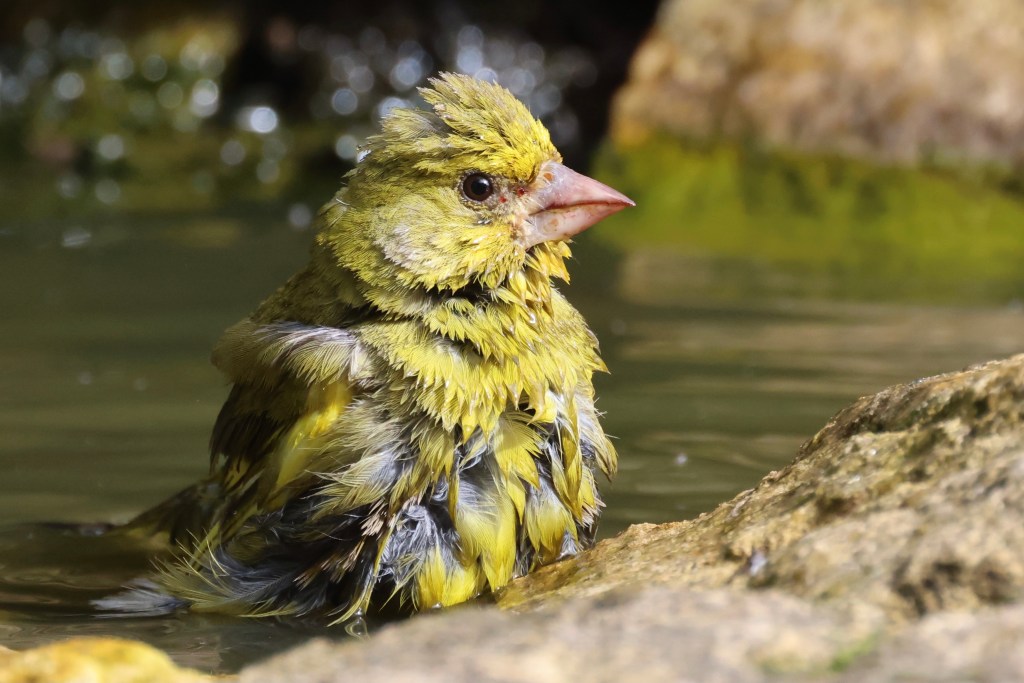
A common, large finch of gardens, parks, woodland and farmland. The Greenfinch is a chunky-looking finch, with the male bird having an olive-green back and bright yellow patches on its wings and tail, and the female having duller plumage with streaky upper parts. Juvenile Greenfinches are similar to the female, but browner. In the U.K. there are around 1,700,000 breeding pairs. Further birds migrate to the UK for the winter months from Scandinavia and Central Europe.
Ringing has shown that individual birds will move 2000 miles , but British breeding birds seldom move more than 20 miles from their birthplace.
Most of the greenfinches that breed in the UK are sedentary, seldom moving far. A few, however, will travel much longer distances, spending their winters in Ireland or continental Europe. Individual birds may behave differently in different years, which suggests that the movements are driven by high breeding densities or food shortages during late summer, rather than annual weather

You may hear male Greenfinches beginning to sing in late January, ready for partnering from around late February. They like to nest within evergreen shrubs. The nest itself is built from twigs, moss and grass, and the most common lining is hair. Breeding starts in April and the usual clutch consists of between 3 – 8 eggs. Incubation lasts between 12 – 14 days. The eggs are a smooth, glossy white and have blackish markings.
Greenfinches are sociable birds, and often feed in company with other ground-foraging species, including tree sparrows, linnets, yellowhammers and reed buntings
Greenfinches rely on seeds and their large bills allow them to be able to eat a wide variety. They show some preference for seeds held within fleshy fruits, such as rosehips, though often ignore the fruit and just eat the seed. During the autumn, seeds from yew and hawthorn are important, and in the winter, bramble. In gardens, they like sunflower seeds.

A recent decline in numbers has been linked to an outbreak of trichomonosis. Trichomonosis is a virulent parasitic infection that has been notable in the recent, sharp declines of, primarily, Greenfinches and Chaffinches, although the disease has affected other garden bird species such as pigeons, House sparrows, Dunnocks, Great tits and Siskins. It affects the back of the throat making it difficult for Greenfinches to feed.
The greenfinch is one of Europe’s most widely distributed birds, breeding from the Mediterranean to the arctic, but absent from Iceland
Trichomonosis can cause excessive salivation and vomiting, which means the disease can spread relatively easily while birds are feeding on feeders. The disease spreads dramatically throughout the breeding season when parent Greenfinches feed their young. This has led to the Greenfinch being added to the U.K. Red List for endangered species in 2021. As with most wildlife in the U.K. the Greenfinch is protected under the wildlife and countryside act , 1981.

©️ wildonline.blog 2026 , all rights reserved


 Wildonline.blog
Sadly this is one bird I no longer see, it must be all of 10 years since I last saw a Greenfinch in our location.. ☹
LikeLike
They are getting scarce. In the last place we lived, after shaping the garden, we had first one, then two, three and in the end five of them. And a neighbour told me that she also had seen them in her garden. So at least there they got a footing again. The only thing I miss from there are the birds. Here in the new place we only have the very usual suspects, blackbirds and sparrows (field and house), no finches, no tits. 😦
LikeLiked by 1 person
Still , I love blackbirds , very cheeky birds with real character
LikeLike
I do too, they are very clever. I have small transparent feeders for the windows, usually only for small birds, but the blackbirds learned how to land on the thin edge, pressing the tails under the feeder to stabilize themselves. One of them even sat inside on a very rainy day :-D. Here at the new place, one male blackbird tried twice but then didn’t follow up on it. It is easier on the ground, I guess, and we don’t have so many cats here. I love all birds. I also feed the big birds, wood pigeons, magpies, jackdaws and a pair of hooded crows. I have a place out of sight from the windows for them, so they can be in peace.
LikeLike
They certainly need help. It’s also good for the soul seeing the birds in the garden
LikeLike