
The Great Tit – Parus major
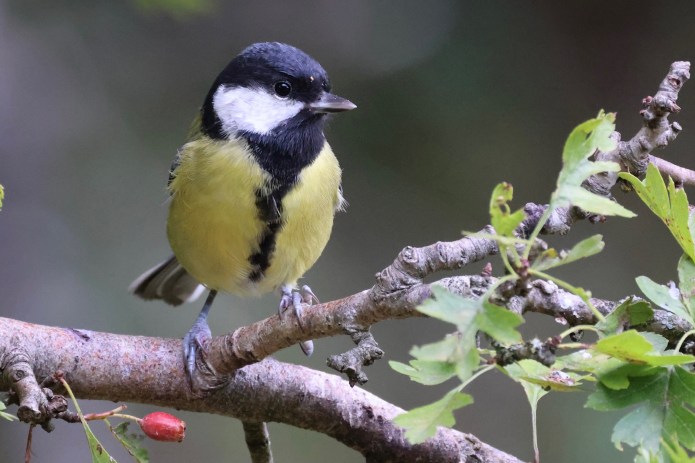
The Great Tit , Parus major is the largest bird in the tit family. It is also the most widespread and common family member with birds found in Britain , mainland Europe , the Middle east , Asia and North Africa. This woodland bird tends to be resident in all but the extreme climates and normally does not migrate.
Britain’s population of around 2 million pairs puts it in 8th place in Europe. Germany has the most: an estimated 8 million pairs.
The Great tit , is a distinctive looking garden visitor with it’s white and black head. The largest of the tit family it has a wingspan of up to 26cm , with a body length of between 12-14cm and body weight up to 20g. It has a bright yellow breast with a broad black stripe and blue-green wings. the female has the same colouring as the male with slightly duller colours.

The Great Tit can be found in a wide range of habitats including all types of woodland , parks and urban gardens. The bird is generally not migratory and once established will normally stay in their territory all year round. Young birds will be chased away by their parents but will normally stay within 10 miles from their nest site.
A great tit clutch can be anything from five to 11 eggs, with the female doing all the incubation.
In Britain the Great Tit breading season normally begins in March . Nests are formed in cavities in trees and walls, the birds are also willing occupants of bird nesting boxes. the nests are built by the female bird and made of hair, moss, feathers and grass/plant materials. The number of eggs in each clutch varies from as few as 5 up to 12 eggs.

The mating pair can have a second brood later in the year an these tend to be much smaller in numbers. The mother takes on all the incubation duties , the male’s main role being supply of food. the incubation period lasts up to 15 days and the chicks hatch blind and unfeathered. Both parents are evolved with feeding the chicks with food within the nest for the next 20 days . Survival rates for the young are low with an average of 40% making it to adulthood.
It is becoming increasingly rare for British-ringed great tits to be recovered abroad. This is thought to be because of the increase in the amount of food available in gardens
The Great Tit diet is insectivorous , feeding on insects, spiders, ants and during the breading season caterpillars. in autumn and winter they supplement their diet with fruit , berries and seeds. they often forage for food on the ground and often visit bird feeders and tables in suburban gardens. Large food items, such as large seeds or prey, are dealt with by holding the food with one or both feet and then struck with the bill until it is ready to eat. Using this method, a great tit can get into a large nut like the hazelnut in around 10-15 minutes. When feeding young, adults will hammer off the heads off large insects to make them easier to consume.

The Great Tit has many predators , birds of prey like the sparrow hawk , domestic cats and nest raiders like the Great Spotted Woodpecker , Grey Squirrel and Weasels. The Great Tit is classified as a least concern species on the IUCN Red List and despite fluctuations in numbers from one season to the next , has seen stable numbers from one decade to the next., as with most wildlife in the uk the Great tit is protected under the wildlife and countryside act , 1981.
© wildonline.blog 2026 , all rights reserved


 Wildonline.blog
Great pictures and info 💚💛🧡❤️🩷
LikeLike
Thank you Emma
LikeLike
Lovely photos
LikeLike
Thank you Debbie
LikeLike
Great article, just about the right amount of information and good images as well , well done you
LikeLike
Thank you Moh
LikeLike
Thank you mon much appreciated
LikeLike
Beautiful photos!!
LikeLike
Thank you Nora
LikeLike
Beautiful
LikeLike
Thank you
LikeLike