
The Wren – Troglodytes troglodytes
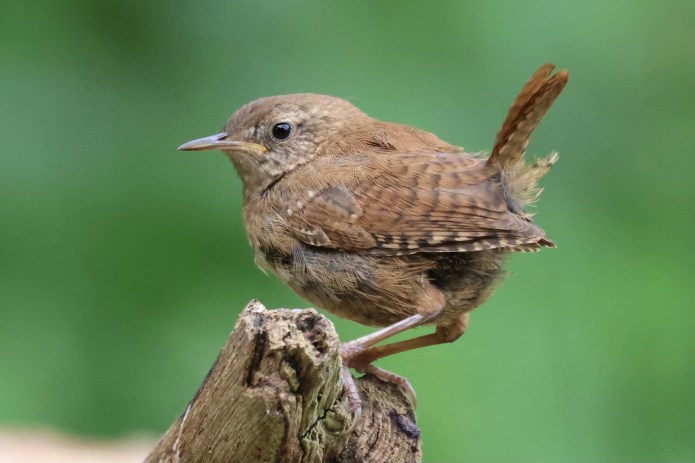
The wren is a small brown bird, almost rounded, with a fine bill, quite long legs and toes, very short round wings and a short, narrow tail which is often cocked up vertically. Wrens can be found across the whole of the UK in a wide range of habitats – woodland, farmland, heathland, moorland and islands. Most are found in deciduous woodland but they are a regular visitor to most gardens. The Eurasian wren, a member of one of 19 genera covering 45 species that embrace much of the globe. Wrens are found across every landmass and on virtually every island. Even the Falklands have their own version, Cobb’s wren. Most British Wrens are sedentary though some move up to 250 km (150 miles) into more sheltered habitats, such as reed beds, for the winter.
An adult wren weighs about the same as a £1 coin. They are the lightest birds found in Britain the exception of the firecrest and goldcrest.
The wren delivers a powerful song, which becomes an angry chatter when an intruder, human or otherwise, passes through their territory. The female becomes particularly vocal if her newly fledged brood in her nest. The loud song from such a small throat is possible because birds have an organ called a syrinx with a resonating chamber and membranes that utilise virtually all the air in the lungs and can produce two notes at the same time.

The male is territorial, defends his patch against other males, builds several alternative unlined nests and whistles up a female. The birds store very little body fat and lose heat easily. During a severe winter, anything from a quarter to three-quarters of the population risk death. The birds including the male will huddle together in large groups of up to fifty in number.
Around 35 to 44 different subspecies of wren have been identified worldwide, which differ in size, overall colouration and the extent of barring on the plumage.
The Wren is the most common breading bird in the U.K. Wrens will use open-fronted and tit nest boxes, both for nesting and winter roosting .The male bird constructs several globe-shaped nests in holes in walls, banks, trees, or old nests from leaves, grass and moss. When the female has chosen a nest, she lines it with feathers. The male bird may mate with several females – all of which can go on to successfully have young. Incubation is by the female only of the 5-6 eggs, with two broods per season normal. The smooth, glossy eggs are white with reddish spots, and about 16 mm by 13 mm. Incubation is by the female only. The young are fed by both parents.
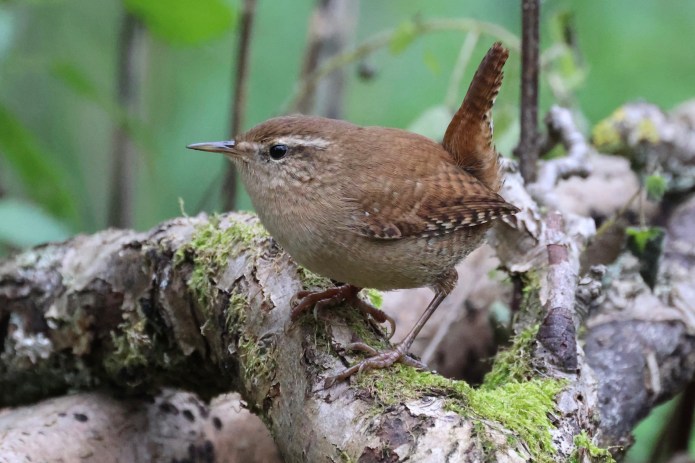
Insects, insect larvae and spiders make up the Wren’s diet, with a limited amount of small seeds also eaten. With winter food scarce, wrens may forage under the snow for their natural diet of insects and spiders, their small size allowing them into areas that other birds can’t penetrate, an ability that applies throughout the year as they can reach cavities denied to larger beaks.
In colder months, wrens often engage in communal roosting to keep warm
The UK population trend for the Wren, especially in England, has been one of moderate increase. Overall though, the population is seen as stable – with the exception of the huge population crashes occur during harsh winters. When this happens though, the species is usually able to quickly bounce back due to its prolific breeding habits . Classified as Green in the UK under birds of conservation concern , as with most wildlife in the UK the Wren is protected under the wildlife and countryside act , 1981.
©️ wildonline.blog 2026 , all rights reserved


 Wildonline.blog
We have one that seems to be living under our terrace facing south. It is well aired, and the cats cannot get in there. I even saw it at the feeding places among the other birds, that’s rare.
LikeLike
We have a pair at the meadow , very flighty and they don’t stay still for long.
LikeLike
Haha, what birds do? I love the wrens, but then, I love them all. 🙂
LikeLike
Love the little wren , lovely bird. And good photography.
LikeLike
Thank you Alan
LikeLike
Oh I loved learning more about our sweet little wren.. I remember being in our allotments one time, and hearing the most beautiful bird song… I looked and there she was sitting on top of the bean pole… Singing her little heart out… I am a big fan of the wren… And we have one maybe two visit our garden.. though I have only ever seen one at a time.. And interesting about their weight the same around our £1 coin.
Gorgeous photos Peter. thank you x
LikeLike
Thanks you Sue
LikeLike
Love the little wrens we have here in the US with their short little tail defying their small stature but seemingly increasing their attitude.
LikeLike
Definitely got a lot of attitude for a small bird. But fun to watch.
LikeLike
Great blog
LikeLike
Thank you Sharron
LikeLike
Lovely little bird ❤️❤️❤️❤️❤️❤️
LikeLike
Thank you Amanda
LikeLike
I had no idea it was so small , and cute
LikeLike
Thank you Debbie
LikeLike