
The Little Owl – Athene noctua
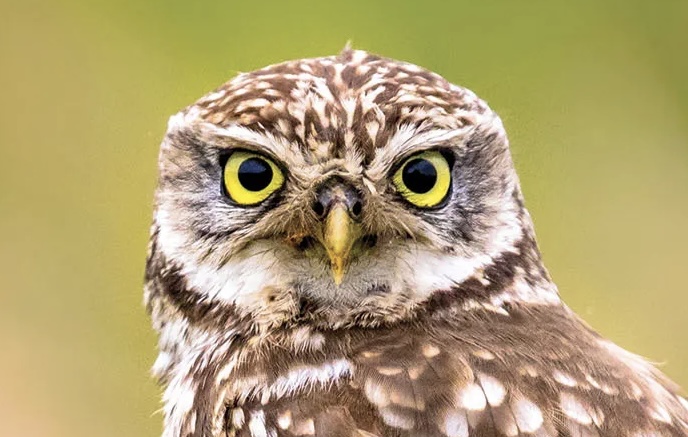
The little owl was first introduced to the UK in the 1800s. Look out for them in trees overlooking grassland from where they swoop down to catch small prey with their sharp talons. The little owl makes its home in small copses, on parkland, around farms and in orchards and open woodland. It is found across England and parts of Wales but is absent from Scotland and Northern Ireland. Little owls have a short average lifespan , 3 – 4 years in the wild mainly due to high juvenile mortality, but can live much longer, with the oldest known wild bird reaching nearly 14 years
Much of their hunting is done on foot, with the birds running actively to capture their prey
Little Owls are most active at dawn and dusk, and after dark when most hunting occurs. However, they can frequently be seen during the middle of the day, basking in the sun on an exposed perch such as a telegraph pole, dead tree or isolated building. Rather than hunting on the wing, Little Owls usually hunt from a perch, typically a fence post. When prey is spotted they sometimes ‘bob up and down’ a few times before a typically short, low, undulating flight to the ground where they sometimes pursue prey on foot.
The Little Owl’s diet consists of mostly small mammals and birds but will also feed on large invertebrates, such as beetles, crickets and worms. It hunts at dawn and dusk, observing the ground from its perch for movement. Once the little owl spots its prey, it swoops, grabbing its meal in its claws or beak.
The whole UK population is thought to originate from introductions on large estates in Kent and Northampton.
The little owl is monogamous, often staying with the same partner for life or until one of the pair dies. The owl is ready to breed when it reaches one year of age. It nests in small holes in trees or sometimes, surprisingly, disused rabbit burrows. The young are raised between May and July . The female little owl lays eggs on alternate days with a total number of eggs normally around 3 – 5. They are incubated for about a month. Both parents raise the chicks, which fledge around 4-6 weeks old but stay dependent for a few more weeks, with successful breeding reliant on food and weather.
Conservation status
The UK’s little-owl population is in decline, having fallen by 20% since 1995. While it is unclear why the species is declining, some suggest it may be due to more intensive farming methods. The Little Owl is an introduced species, however it is still fully protected in the UK under the Wildlife and Countryside Act 1981 ,making it illegal to intentionally kill, injure, take, or disturb them, their nests, eggs, or young.
©️ wildonline.blog 2026 , all rights reserved


 Wildonline.blog
Beautiful portrait!
LikeLike