
The Pheasant – Phasianus colchicus

Easily recognisable, the pheasant is a common sight in the countryside and can be found all over the great Britain. This non native bird was introduced by the Romans over a thousand years ago so there is an argument that it is now part of the fabric of our country. The male Pheasant is a handsome large game bird with a long-tail. It has metallic iridescent plumage with brown and black markings on their body and green and red face markings. The female is slightly smaller and less colourful with mottled pale brown markings.
The male Pheasant proclaims its territory with a distinctive two-syllable crow
They usually prefer hedgerows and the fringes of woodlands. The average lifespan in the wild is only a couple of years. Pheasants are released in huge numbers on shooting estates with in excess of 20 million birds released each year in the UK alone. Pheasants nest on the ground, and when startled, will burst to the sky . They can fly fast (up to 60 miles per hour when chased) for short distances, but prefer to run and can get up to speeds of 8 to 10 miles per hour
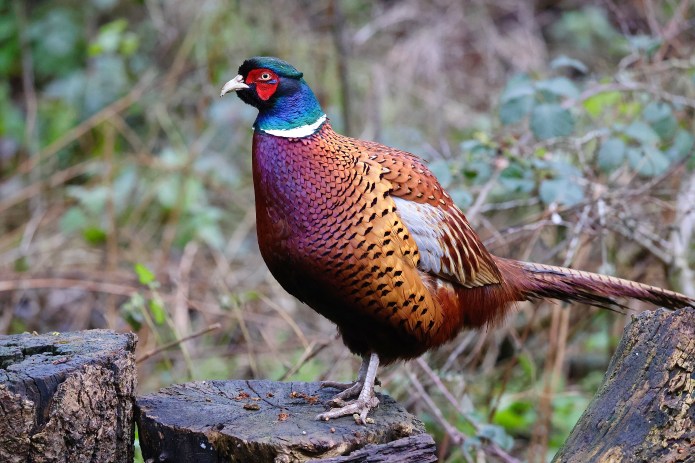
Pheasants are omnivores with a varied diet of plants and animals, primarily eating seeds, grains, berries, leaves, and insects, with their diet shifting seasonally, relying more on protein-rich insects in summer for chicks and energy-dense grains in winter for adults.They forage on the ground, consuming everything from wild fruits, nuts, roots, and buds to worms, snails, lizards, and small rodents, depending on availability.
Cocks can be prompted to crow by distant rumbles of thunder or gunfire. During the First World War, pheasants in Kent crowed in response to the sound of guns in the Battle of the Somme
During the mating season the male bird may mate with many different females , who then raise the chicks on their own. Pheasants nest solely on the ground in scrapes, lined with some grass and leaves, frequently under dense cover or a hedge. Occasionally they will nest in a haystack, or old nest left by other birds. A typical clutch can range from 2 to 22 eggs , however large clutches are usually the result of two hens sharing the same nest site. The chicks can feed themselves soon after hatching but will still remain with their mothers for up to three months before becoming independent.
Conservation status
As an introduced species there are no notes of conservation concern , as with all wildlife the Pheasant has limited protected in law under the Wildlife and Countryside Act , 1981.
©️ wildonline.blog 2026 , all rights reserved


 Wildonline.blog
Pretty!!
LikeLike