
The Short-eared Owl – Asio flammeus
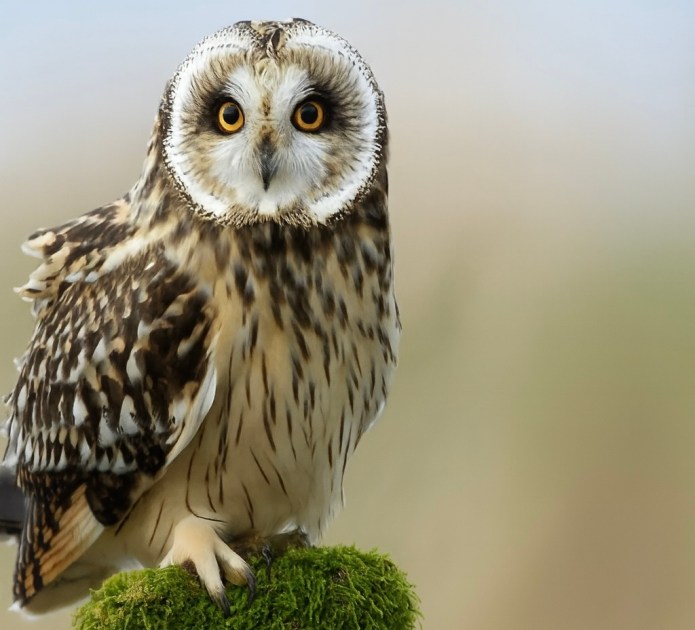
The short-eared owl is mottled yellowy-brown above, paler underneath and has dark circles around its yellow eyes. Short ‘ear tufts’ provide its common name. These are not actually the bird’s ears, but they do resemble the pointy ear structures of some mammals. The similar long-eared owl is darker with orange-red eyes and long ear tufts and is usually found near woodland.
Owls can turn their heads almost completely around, up to 270 degrees
The average lifespan is anywhere between 4 – 12 years in the wild. Their numbers in the UK fluctuate wildly with vole cycles, but current estimates suggest roughly 620 to 2,180 breeding pairs with numbers swelling significantly in winter with the arrival of Russian and Scandinavian migrants

Short-eared owls mainly hunt during the daytime, flying low over moorland, grassland and salt marshes where they feed on field voles and small birds. Their diet also includes mice, shrews and occasionally bats, and large insects like grasshoppers
Short-eared Owls nest on the ground in open country, where the female scrapes a hollow and lays 4-9 white eggs. The female incubates the eggs for around 30 days , while the male provides food . The chicks fledge around 26-32 days, though their survival depends heavily on prey availability.
Conservation status
While not globally endangered, the Short-eared Owl is a species of significant conservation concern, particularly in the UK where the Short-eared Owl is listed as amber , a Species of Conservation Concern . Like most wildlife they are protected in law by the Wildlife and Countryside Act (1981)
©️ wildonline.blog 2026 , all rights reserved


 Wildonline.blog
Great shots!
LikeLike