
The Eider Duck – Somateria mollissima
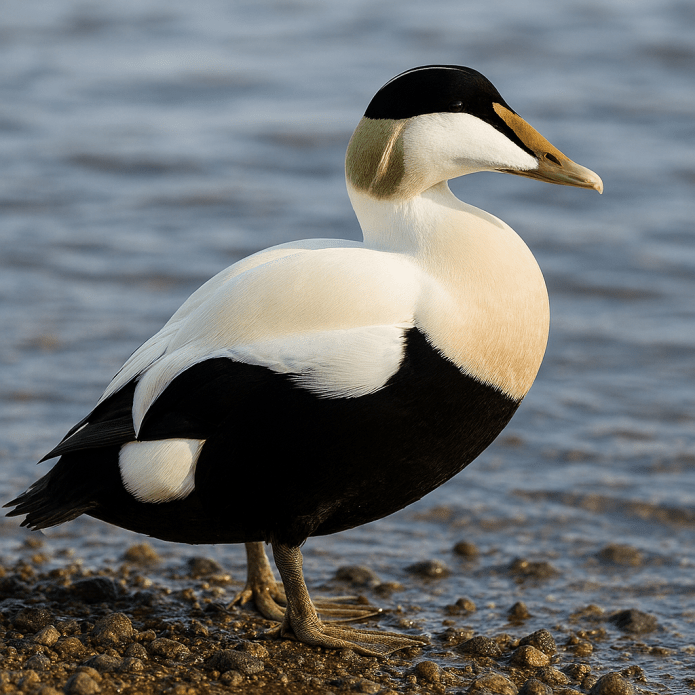
The Eider is the UK’s heaviest Duck weighting anrounf 2.2kg annd despite its size also the fastest flying duck. It’s a true seaduck, rarely found away from coasts. Its reliance on coastal shellfish for food has brought it into conflict with mussel farmers. Eiders are very sociable and usually stay close to shore, riding the swell in a sandy bay or strung out in long lines beyond the breaking waves.
This Eider, the largest duck in the Northern Hemisphere
The male eider is a black-and-white duck, with a pale green patch at the back of the head, pinkish breast and pale yellow-grey bill. The female is greyish-brown with delicate barring. It has a wing span of around 95cm and an average lifespan in the wild of around 8 years.

The Eider feed on Mussels and other molluscs, together with crustaceans and echinoderms. These are taken during dives, typically down to 3 m or so. Individuals favour sheltered feeding and resting sites during the winter, reducing their exposure to the elements.
The Eider breeds and makes its nest on coastal islands from April to May. This colony nesting bird build ground nests lined with their own down, laying 4-6 greenish eggs incubated for five weeks . The chicks then forming crèches soon after, exhibiting strong family bonds and cooperative care. The males often leave the colony once incubation begins, while females foster communal care, sometimes even sharing nests and raising large groups of ducklings.
Conservation status
The Eider was famed for its soft feathers and hunted to almost extinction in the late 19th century. Now the Eider duck like most wildlife here in the UK is protected in law by the Wildlife and Countryside Act 1981 , which makes it illegal to kill, injure, or disturb them in the UK. Listed as Amber under the Birds of Conservation Concern 5: the Red List for Birds (2021). Listed as Near Threatened on the global IUCN Red List of Threatened Species.
©️ wildonline.blog 2026 , all rights reserved


 Wildonline.blog
Amazing duck photos
LikeLike