
The Hooded Merganser – Lophodytes cucullatus
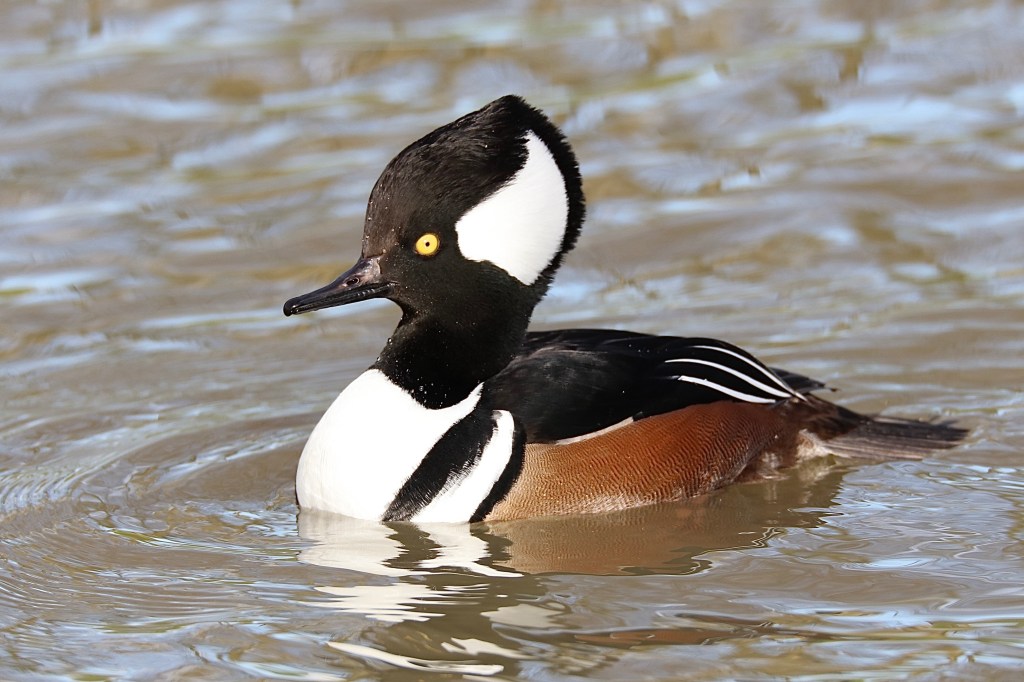
Hooded Mergansers are the smallest of the three merganser species, their range is normally restricted to North America. However they are a rare sight here in the uk , most of which are probably birds that have escaped from wildfowl collections.. Males are easily distinguished by the white, fan-shaped crest on their black head. The neck and back are black, with long white and black tertial feathers, the sides are brown, but have notable black and white vertical stripes towards the breast, and the belly and breast are white. The bill is narrow and black. Females are brown-grey overall with a gray-brown crest, a white belly, and a narrow yellow grey bill.
These ducks are fast flyers, capable of reaching speeds of up to 80 km/h
They are cavity nesters, relying on natural tree holes or artificial nest boxes, often high above the ground. Females typically lay a clutch of 7–15 eggs and incubate them alone; males leave the female after she has laid her eggs. The precocial ducklings leave the nest within 24 hours of hatching, fearlessly fluttering to the ground from heights that can exceed 15 metres.
Hooded mergansers primarily inhabit small bodies of freshwater such as ponds, small estuaries, wetlands, and flooded timber, preferring areas with ample aquatic vegetation and mature trees for nesting. They are expert divers and specialize in eating fish, a behavior for which they are well-adapted. Their bill is thin and serrated, which allows them to effectively grip slippery prey, leading to the nickname “sawbills”. Their diet also includes aquatic insects, crabs, and crayfish.
Conservation status
The population of the hooded merganser appears to be stable or possibly increasing in their home range of North America. Conservation efforts, such as proper timber management to ensure the availability of mature trees for nesting and the use of artificial nest boxes, have likely contributed to their success after historical population declines linked to deforestation.
The species is currently classified as “Least Concern” by the IUCN. birds are not classified here in the UK under the Birds of Conservation Concern 5: the Red List for Birds (2021). But they are protected. in the UK under the Wildlife and Countryside Act, 1981.
©️ wildonline.blog 2025 , all rights reserved.


 Wildonline.blog
Spectacular species.
LikeLike
Beautiful!
LikeLike
Beautiful
LikeLike