
The Tufted duck – Aythya fuligula
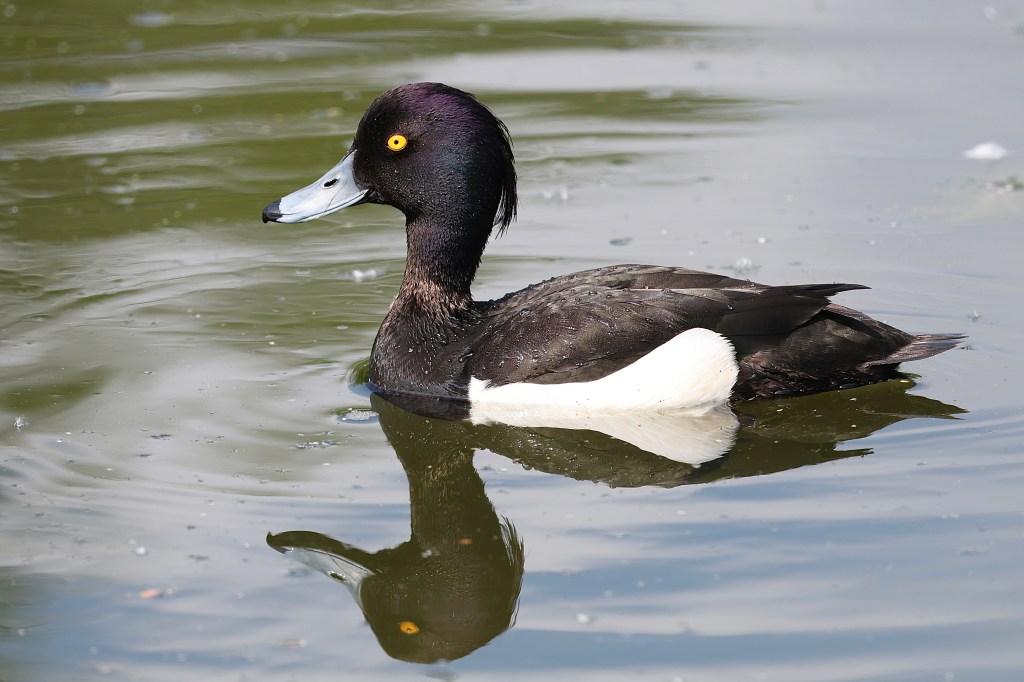
The Tufted Duck is a medium-sized diving duck, typically weighing around 750g with a wingspan of 45cm , so smaller in size than a Mallard. It’s black on the head, neck, chest and back, and white on the sides. It has a small crest and a yellow eye. In flight it shows an obvious white stripe across the back of the wing. The average lifespan in the wild is around four years.
The scientific name of the tufted duck, fuligula, means ‘sooty throat’
It breeds in the UK across lowland areas of England, Scotland and Ireland, but less commonly in Wales, with most birds being year-round residents. Breeding takes place between mid May and the end of July. They are not colonial but sometimes the nests can be in a loose group. Most nests are placed beside water; an island site is preferred. The nest is built by the female and consists of depression in the ground that is lined with grass, reeds and down. Like most ducks, the ‘drake’ (male) has nothing to do with the incubation of the eggs or raising the young. The ‘hen’ (female) has eight to eleven eggs in a brood; the young becoming independent once their true feathers have fledged.
These birds feed mainly by diving, but they will sometimes upend from the surface.They eat molluscs , aquatic insects and some plants and sometimes feed at night.
Numbers increase in the UK in winter because of birds moving to the UK from Iceland and northern Europe. It is thought that there are around 18,000 resident dreading pairs here in the uk.
Conservation status
Classified in the UK as Green under the Birds of Conservation Concern 5: the Red List for Birds (2021). Protected in the UK under the Wildlife and Countryside Act, 1981.
©️ wildonline.blog 2025 , all rights reserved.


 Wildonline.blog
1 reply »