
The Whitethroat – Sylvia communis
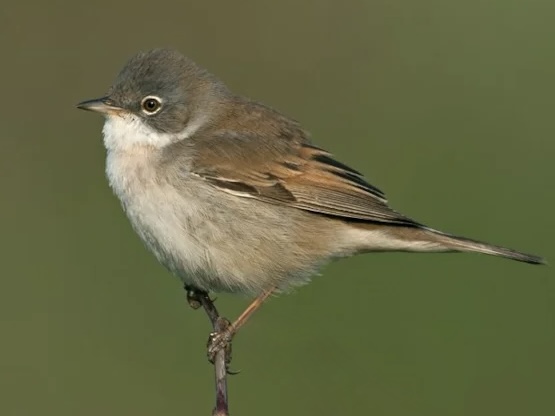
The whitethroat is a medium-sized, long-tailed warbler of grassland, scrub and hedgerows. It is a summer visitor and passage migrant, breeding in many areas, but avoiding urban and mountainous places. Male whitethroats are sandy-grey above, with pale grey heads, pinkish-buff breasts and bright white throats. Females are duller. They are larger than lesser whitethroats, have longer tails, and sport rusty-brown edges to their wing feathers. They winter in Africa, leaving our shores in early October and heading as far as South Africa.
Male whitethroats arrive in the UK about 10 days earlier than females in order to set up territories before their potential partners arrive.
They are known for their curiosity, which is evident by their boldness to investigate disturbances in near surroundings. If there is a threatening intruder, the Whitethroat will usually try to fend it off with an aggressive, rapid churring call. Because the bird appears in a number of areas around the world, it has been given a number of names, including “nettle creeper”, “beardie” and “hay jack”.
A drought in the western Sahel region of Africa in 1968 caused a 90% drop in the number of whitethroats breeding in the UK. Numbers are yet to fully recover from this crash.
During the breeding season the diet is made up mainly of insects, but on autumn migration and on the wintering grounds it is chiefly berries.
Whitethroats build their nests primarily out of dry grass and roots, the lining of which is made from wool, finer roots and/or plant down. The nest is usually built in low shrub or brambles and among bushes in the open country. A typical clutch consists of between four and five eggs, with a hatching period of approximately eleven to twelve days. It is the duty of both males and females, which take responsibility in turn, to incubate the eggs and, once hatched, the subsequent fledgling period takes place around twelve days later.
Insects and invertebrates are the main food source for whitethroats. It will forage in low vegetation, snatching any bugs, beetles and other minibeasts it comes across. Berries and other soft fruit may also be taken if available.
Classified in the UK as Amber under the Birds of Conservation Concern the Red List for Birds (2021).
©️ wildonline.blog 2026 , all rights reserved


 Wildonline.blog
1 reply »