
The Cuckoo – Cuculus canorus
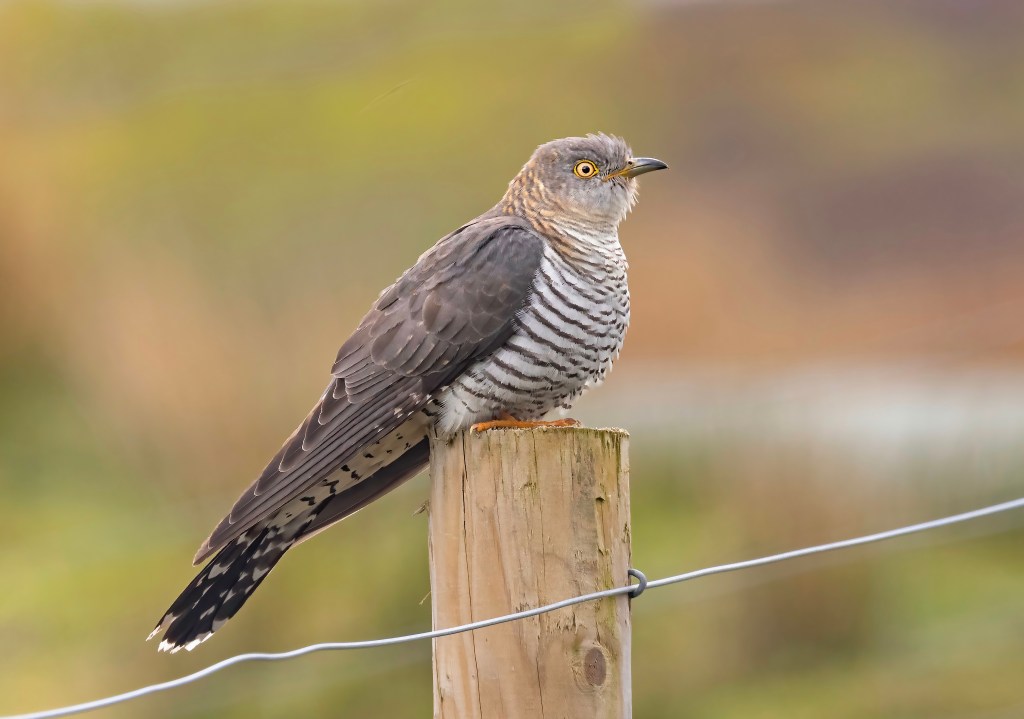
The Cuckoo is a dove-sized bird with blue grey upper parts, head and chest with dark barred white under parts. With their sleek body, long tail and pointed wings they are not unlike and sometimes confused with Kestrels or Sparrowhawks. Both sexes are similar in size and appearance .Young cuckoos are even more strikingly patterned than their parents. Their entire plumage is criss-crossed of strong, dark stripes. The young’s back and wing feathers are also dotted with brown spots and there is a prominent white patch on the young bird’s neck.
Cuckoos can be seen throughout Britain, but are more numerous in southern and central England. The cuckoo lives in a wide range of habitats. It can be found in sparse forests, but also in farmed landscapes with structures such as hedges or other tall vegetation. The birds only avoid very dense woodland. And of course, the presence of a cuckoo depends on the location of its host bird species.
The Cuckoo spends up to nine month of the year in tropical Africa
Considered to be an early sign of spring, the song of the cuckoo sounds the same as its name: ‘cuck-oo’. It can be heard in woodlands and grasslands. The cuckoo is a summer visitor to Britain, arriving from Africa in late March and April. They are famous for laying their eggs in other birds’ nests, fooling them into raising their young. Dunnocks, meadow pipits and reed warblers are common victims of this.
Each season a female will lay between 12 and 22 eggs, all in different nests.
Young cuckoo chicks grow much bigger than their unsuspecting foster parents and will often push any other eggs out of the nest. Since the cuckoo does not incubate its own eggs, it basically has no incubation period. The time of egg-laying depends on that of the host bird species and takes place shortly after or even at the same time. Cuckoo eggs have a short incubation period of about twelve days, so the cuckoo chick usually hatches before the host bird’s offspring. Cuckoo chicks fledge from the host nest at around three weeks of age and are then fed for two more weeks before they become independent.
Young and adult cuckoos like to eat all kinds of insects, but hairy caterpillars are their favourites! They hunt insects, spiders, worms and other small animals. Sometimes they even eat small frogs and other amphibians.
There are 54 species of Old World cuckoos, but just two live in Europe
Classified in the UK as Red under the Birds of Conservation Concern 5: the Red List for Birds (2021). Priority Species under the UK Post-2010 Biodiversity Framework. Listed as Vulnerable on the global IUCN Red List of Threatened Species.
©️ wildonline.blog 2026 , all rights reserved


 Wildonline.blog
1 reply »