
The Red Admiral – Venessa atalanta

The Red Admiral, Venessa atalanta is probably one of Britains recognised spices of butterfly and can be found in almost all habitats from gardens to our sea shores , mountains to town centres. It’s a common sight in throughout the British isle and recent studies seem to suggest that its numbers are on the increase.
The name ‘red admiral’ apparently comes from a corruption of the original 18th-century name ‘red admirable’.
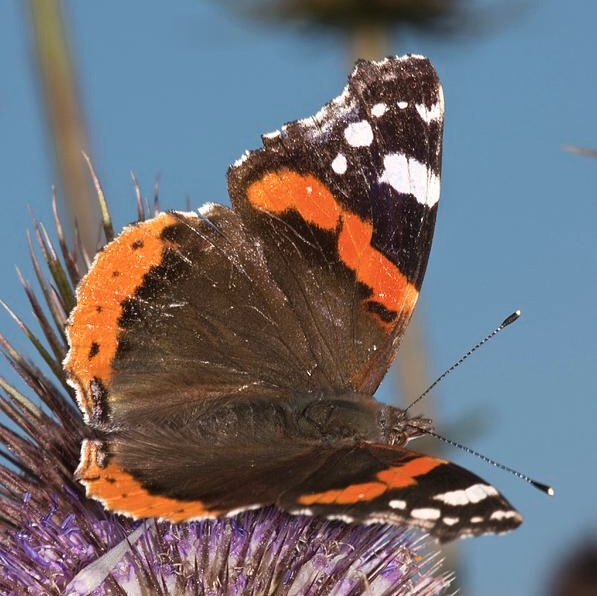
The red admiral is mainly black, with broad, red stripes on the hindwings and forewings, and white spots near the tips of the forewings. Most Red Admirals we see here in the U.K. are migrants that fly here from Continental Europe and North Africa , arriving in spring . Some adults do over winter here in the U.K. and there is evidence this number is growing.
Male red admirals court females for several hours before they begin mating. Because of female choice, only males with territory have the opportunity to mate. Females select males with traits that will increase the mating success of their offspring. In order to maintain their territory, males fly around and patrol the area 7 to 30 times per hour. Only males of exceptional flying ability are able to chase off intruding males and successfully court females.
The male Red Admiral will patrol his territory up to 30 times per hour.
Mating usually occurs in late autumn or early winter following collective migration to southern regions with a warmer climate. The red admiral’s main host plant, the stinging nettle, is most abundant during this migration. Eggs are laid singly on the upper surface of a leaf of the foodplant and several eggs are often laid in the same nettle patch. They are light green at first, but turn darker as the larva develops. Eggs hatch in about a week.
The larva lives within a tent formed by folding the edges of a leaf together, emerging only to feed. As the larva grows it will form a new tent. The larva of this species is one of the easiest to find in a nettle patch, since its location is given away by a series of tents that are highly-visible to the trained eye. The larva is usually found in the largest of these tents.Larval development proceeds through winter and adults are first sighted in early spring. The new generation of adults migrates north before mating, because food is usually diminished by late spring.
Adults feed during the day, feeding on the nectar of flowers such as ivy, buddleia and other garden plants. Towards the end of summer and into autumn, fallen and rotting fruit also provides an important source of sugar.
©️ wildonline.blog 2026 , all rights reserved


 Wildonline.blog
1 reply »