
The Canada goose – Branta canadensis
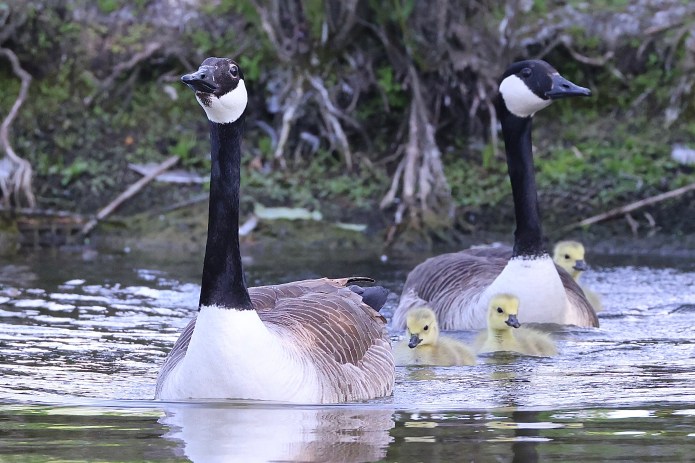
The Canada goose , the largest resident goose here in the uk is a non native species introduced from North American approximately 300 years ago. It’s now a common sight across the whole country nesting on lakes , gravel pits and reservoirs.The Canada goose is distinctive and easily recognisable with a black neck and head, grey-brown back and white cheek patches.
Canada geese were first introduced to the UK in St. James’s Park, London, in the 17th century. Today, the population is over 150,000 birds
While North American populations are highly migratory, those here are largely sedentary. However, many individuals make a significant moult migration to favoured sites, such as the Beauly Firth, where they complete their annual moult. Each goose has about 20,000-25,000 feathers. They’re short and stubby to insulate from cold water. However, the bird will replace them each year. Moulting in the breeding season, Canada geese are grounded for three to five weeks and get their wings back around the same time as their goslings take flight.
Canada geese are monogamous and generally mate for life. They pair up when they’re about two years old and might find another mate if one dies. These birds practice assortative mating, meaning they choose mates of a similar size. Females lay around five eggs in their nest, which is protected by both parents. They typically build their nests by water – you might find one along the canals and lakes. During the mating season and when they have goslings geese can be very territorial and turn aggressive if you get too close. After incubation, lasting about a month, goslings hatch and are immediately able to walk, swim and find food.
Canada geese fly in a distinctive V-shaped flight formation, with an altitude of around 1 km (3,000 feet) for migration flight. The maximum flight ceiling of Canada geese is unknown, but they have been reported at 9 km (29,000 feet)
Parents are often seen leading their goslings in a line, usually with one adult at the front and the other at the back. While protecting their goslings, parents often violently chase away nearby creatures, from small blackbirds to lone humans who approach , first giving a warning hiss, and then attacking with bites and slaps of the wings. Although parents are hostile to unfamiliar geese, they may form groups of a number of goslings and a few adults. The offspring enter the fledgling stage any time from six to nine weeks of age. They do not leave their parents until after the spring migration, when they return to their birthplace
Canada geese are herbivores, mainly eating green vegetation, grains and water plants. They eat grass by grasping the blade with their bills and tearing it with a jerk of their heads. Occasionally, they’ll also eat small insects and even small fish.
The lifespan in the wild of geese who survive to adulthood ranges from 10 to 24 years.. The oldest record age here in the uk was held by a specimen tagged as a nestling, which was observed alive at the age of 31. Once they reach adulthood, due to their large size and often aggressive behavior, Canada geese are rarely preyed on, although injury may make them more vulnerable to natural predators. Their current conservation status is a species of least concern and as with most wildlife they are protected in law by the Wildlife and Countryside Act 1981.
©️wildonline.blog 2026 , all rights reserved


 Wildonline.blog
1 reply »