
The Robin – Erithacus rubecula
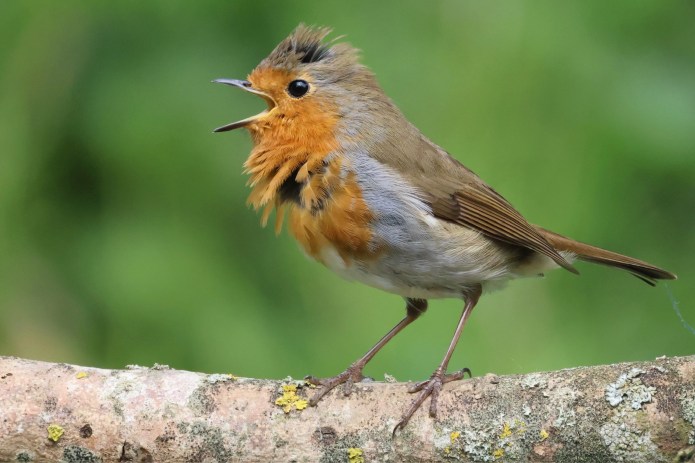
The Robin , a familiar sight in British gardens and parks is a small rounded bird with a distinctive red plumage on it’s breast. A firm favourite in our garden and a regular visitor to the wildflower meadow hide this little bird sometimes called the Robin Redbreast is embedded deep into British folklore, and has a strong association with winter life here and in particular the traditional British Christmas.
The Robin is a year round resident in the UK, but a small minority of female Robins migrate to southern Europe during winter, a few as far as Spain. Both the male and female feature similar plumage, both with the distinctive red breast. The male bird is extremely territorial and will aggressively defend his territory, attacking any similar sized birds that try to muscle in on their patch.
The Robin is a member of the thrush family , a distant relative of the Blackbird and Nightingale.
The adult European robin is 12cm long and weighs between 15 to 22 g with a wingspan of 20–22 cm . The male and female bear similar plumage; an orange breast and face lined by a bluish grey on the sides of the neck and chest. The upperparts are brownish, or olive-tinged in British birds, and the belly whitish, while the legs and feet are brown. The bill and eyes are black.
Juveniles are a spotted brown and white in colouration, with patches of orange gradually appearing. Male robins are noted for their highly aggressive territorial behaviour. They will fiercely attack other males and competitors that stray into their territories and have been observed attacking other small birds without apparent provocation. There are instances of robins attacking their own reflection. Territorial disputes sometimes lead to fatalities, accounting for up to 10% of adult robin deaths in some areas
Courtship feeding is a very prominent activity, and the male can supply more than a third of his mate’s food intake during nest building and egg laying. This extra food is important and can make a difference to the clutch size, particularly since a complete clutch represents about 90 per cent of the females total body weight. The birds are very sensitive to any disturbance during the nest building and egg laying, and will easily desert the nest if they think that the nest has been discovered. Unless the birds are used to people, it is best to stay clear of the immediate vicinity of the nest until the incubation starts.The cup shaped nest is composed of moss, leaves and grass, with finegrass, hair and feathers for lining is built by the female bird . If you want to help your local Robin population to providing a nesting box to attract Robins to nest in your garden it needs to be open fronted and concealed in vegetation.
Robins may choose a wide variety of sites for building a nest. They will make use of anything that can offer some shelter, this can include some unlikely locations including garden sheds , old discarded kettles , hanging baskets and farm machinery. Two or three clutches of five or six eggs are laid throughout the breeding season, which starts in March in Britain. Once the clutch is complete, incubation is by the female alone for 13 days. The shells of the hatched eggs are removed immediately from the nest by the female, who sometimes eats part of them for extra calcium. The eggs are a cream, buff or white speckled or blotched with reddish-brown colour.
Robin’s will not enter standard nest boxes with round entrance holes.
The chicks hatch naked, and are totally dependent on their parents for food and warmth. Both parents look after the nestlings. Feather growth will become evident with the appearance of quills at three days of age. By five days the eyes start to open and they are completely open by eight days. By this time, rows of feathers will start to appear on backs and flanks. The body is more or less feathered by 10 days. Flight feathers are the last to grow, and as the chicks fledge at 14 days, they will not be able to fly for another couple of days.
The young are tended by their parents for up to three weeks after fledging. Frequently the care of the fledged young is left to the male, while the female prepares herself for the next nesting effort. Robins have two broods a year. Three successful broods a year is not uncommon, and in a good year even four are known.

Because of high mortality in the first year of life, a robin has an average life expectancy of just one year, if the Robin survives past the first year it can expect to live longer Up to a maximum of six years. The cause of the high mortality rate are many and varied. Only around 40 per cent of fledged birds will survive from one year to the next. High levels of mortality are compensated for by high productivity and the robin population has increased by 45 per cent since 1970. Severe winter weather can have severe impacts on robins.
A bird can use up to 10 per cent of its body weight during one cold winters night, and unless able to feed well every day to replenish its reserves, a prolonged cold spell can be fatal. In normal circumstances the fat reserves built up by the bird will keep it going for a few days, but mortality tends to increase rapidly if a cold spell continues into a second week.
Every Robin has a unique breast pattern that can be used to identify individually bird
These multiple broods result in a long breeding season, and nestlings can be found until late July When juvenile birds fly from the nests they are mottled brown in colour all over. After two to three months out of the nest, the juvenile bird grows some orange feathers under its chin and over a similar period this patch gradually extends to complete the adult appearance.
In the 1960s, in a vote publicised by The Times, the robin was adopted as the unofficial national bird of the UK. The bird also is associated with several British sporting clubs including the professional football clubs Bristol City, Crewe Alexandra, Swindon Town, Cheltenham Town and Wrexham FC, as well as the English rugby league team Hull Kingston Rovers.
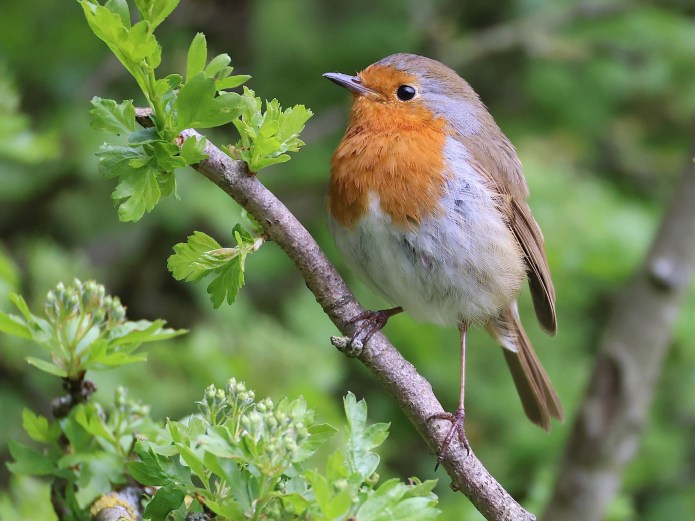
Birdtables can make a big difference to the survival of urban and suburban robins. The favourite bird table treat is mealworms. Other useful foods are meaty kitchen scraps, fat, cheese, cake and biscuit crumbs, and dried fruit. Peanuts are also taken, but they are better shredded or crushed than whole.
©️ Wildonline.blog 2025 , all rights reserved


 Wildonline.blog
3 replies »